
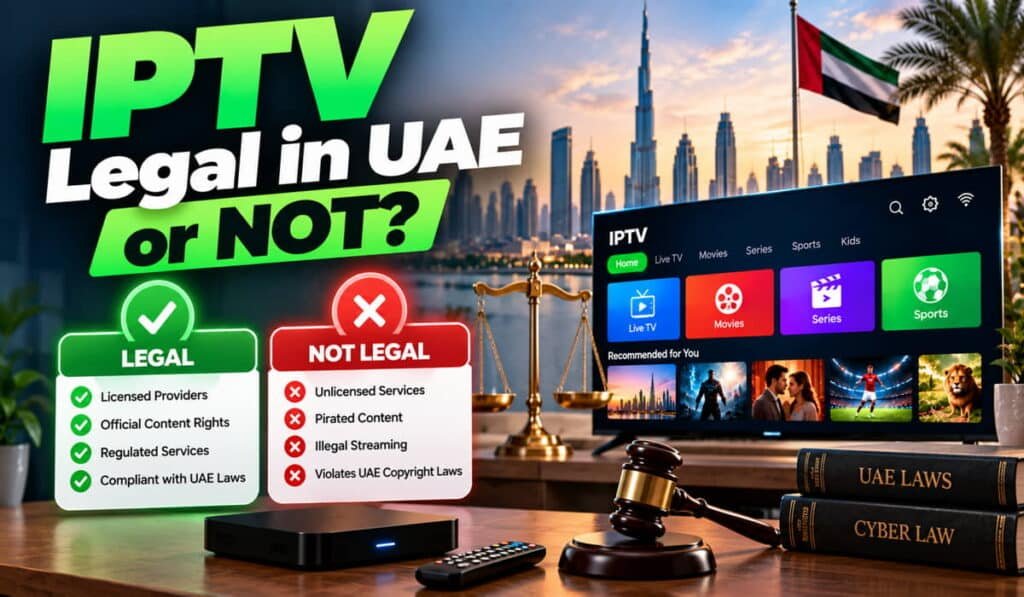
IPTV can be used lawfully in the UAE, but the legality of a particular service depends on its content rights, authorization, and compliance with applicable regulations. IPTV stands for Internet Protocol Television, a method of delivering television and video content over internet networks. The technology itself does not establish whether a service is authorized.
The important distinction is between the app you use, the company supplying the streams, and the rights that company holds for the channels and programmes it distributes. Paying for a subscription does not automatically prove that a provider has permission to offer every item in its catalogue.
If you are considering an IPTV service in the UAE, check the provider’s identity, its explanation of content rights, its terms, and any relevant regulatory requirements before subscribing.
What Does IPTV Mean Under UAE Media Regulation?
IPTV delivers television or audiovisual content through Internet Protocol networks rather than relying solely on traditional broadcast distribution methods. However, the delivery method is only one part of the legal picture.
Three terms help explain the difference:
- IPTV: Television or audiovisual content delivered through IP networks.
- OTT (Over-the-Top): Content delivered through online services over an internet connection.
- VOD (Video on Demand): Content that viewers can select and play when they choose.
These terms describe ways of delivering or watching content. None automatically confirms that a particular provider has the necessary rights to distribute it.
For a technical explanation, read our guide on how IPTV works.
Why IPTV Falls Within the UAE Media Regulatory Framework
The UAE regulates media activities under Federal Decree-Law No. 55 of 2023 concerning Media Regulation, together with its implementing regulations and applicable decisions.
Article 8 of the decree-law includes radio and television broadcasting, including IPTV, OTT services, and video on demand, among the categories of media activities. The framework also addresses licensing and permits, media content standards, and obligations that apply to relevant media activities.
The UAE Media Council explains that media licences and permits are issued by the Council or the competent authority, depending on the jurisdiction and the activity. The applicable requirements depend on the nature of the activity and the responsible party. A licence or permit may also not replace other approvals required from relevant authorities.
This does not mean that every household that installs an IPTV player must obtain a broadcasting licence. Regulatory requirements for a company distributing television content are different from the questions a consumer should consider when choosing a service.
What Makes an IPTV Service Authorized or Unauthorized?
The central question is whether the service has the necessary rights and permissions for the content it offers and complies with the requirements applicable to its activities.
Content Distribution Rights and Copyright
Television programmes, films, sports broadcasts, recordings, and other audiovisual works may be protected by copyright or neighbouring rights.
The UAE’s Federal Decree-Law No. 38 of 2021 on Copyright and Neighbouring Rights establishes protections for qualifying intellectual works and related rights. The specific rights involved depend on the work, the parties involved, and the relevant legal provisions.
Read the official UAE Copyright and Neighbouring Rights legislation.
In practical terms, an IPTV provider needs appropriate authorization for the content and distribution activities it offers. That authorization may vary by country, channel, programme, platform, or period.
For example, a company might have permission to distribute certain television channels but not every premium sports broadcast or film available elsewhere. Authorization for one part of a catalogue does not automatically establish rights for the entire catalogue.
Does Paying for an IPTV Subscription Make It Legal?
No. A payment receipt proves that you paid for a service, but it does not independently prove that the provider has the necessary content-distribution rights or regulatory approvals.
A provider may charge monthly or yearly fees, advertise premium packages, and offer a professional-looking website. Those features do not establish the legal status of its content.
Likewise, an unusually low price alone does not prove that a service is unauthorized. Price should be considered alongside the provider’s identity, content claims, terms, and available evidence of authorization.
Is Free IPTV Legal in the UAE?
Free access is not automatically unlawful, just as paid access is not automatically authorized.
A broadcaster may offer free online streams through an official website or application. Another service might offer content without demonstrating that it has permission to distribute it.
The relevant question is where the content comes from and whether the service is permitted to make it available under the applicable rules.
Is Watching Unauthorized IPTV Illegal in the UAE?
This question requires care because a provider’s distribution activities and a viewer’s actions are not necessarily the same legal issue.
The UAE has media-regulation and copyright frameworks that may be relevant to unauthorized content distribution. However, it would be misleading to claim that every person who watches any IPTV stream automatically faces the same legal consequences.
The circumstances and conduct involved matter.
Consider the differences between these activities:
- Accessing a service: A person watches content through a service whose authorization may be uncertain.
- Recording or downloading content: The user makes a copy, which may raise additional copyright questions depending on the circumstances and applicable law.
- Redistributing streams: A person shares or retransmits protected content to others without the necessary permission.
- Reselling subscriptions: A person sells access to a service or redistributes content as a commercial activity.
- Operating a streaming platform: A business supplies audiovisual content and may need to address licensing, distribution rights, and other regulatory requirements.
These activities should not be treated as legally identical. The relevant provisions, facts, and permissions need to be considered separately.
If you have received a legal notice, are involved in an investigation, or plan to launch or operate an IPTV business, seek advice from a qualified UAE legal professional. This article provides general information, not individualized legal advice.
UAE Copyright Rules and Online Content Restrictions
IPTV legality is not governed by one simple rule that classifies every service as legal or illegal. Different legal frameworks may apply to content rights, media activities, and online access.
Copyright and Neighbouring Rights
Copyright protects qualifying creative works, including audiovisual material. Neighbouring rights may also protect the interests of performers, producers of sound recordings, and broadcasting organizations, as applicable under the law.
These rights matter because distributing a television programme or other protected content may require permission from the relevant rights holder.
A provider’s ability to access a stream does not, by itself, prove that it has permission to redistribute that stream to its customers.
The legal position depends on the rights involved and the relevant circumstances. For precise interpretation, consult the current legislation rather than relying on a provider’s marketing statements.
Internet-Content Restrictions and Intellectual Property
The UAE Government’s guidance on media regulation and internet-content restrictions explains that the country’s Internet Access Management policy includes categories of restricted content, including infringement of intellectual property rights.
This is relevant to online services, but it is important to distinguish website access from legal authorization.
A website being accessible does not prove that its content is lawfully distributed. Equally, a website being blocked does not, by itself, provide a complete legal assessment of every activity associated with that service.
Access restrictions, copyright questions, and media licensing requirements are related but distinct issues.
Media Licences and Other Approvals
The UAE Media Regulation framework provides for licences and permits for relevant media activities. The authority responsible and the requirements involved depend on the activity and jurisdiction.
The UAE Media Council’s official guidance also explains that a media licence or permit does not replace other approvals that may be required from relevant authorities.
For this reason, a business planning to distribute television content should verify its requirements before operating. A consumer, meanwhile, should avoid assuming that a provider’s claims of registration or licensing automatically establish authorization for every channel it offers.
How to Check Whether an IPTV Provider Is Legitimate
Consumers cannot always independently inspect a provider’s licensing agreements. However, you can assess its transparency and ask relevant questions before paying.
Use the following checks as a risk-assessment process, not as a legal certification test.
1. Check the Company’s Identity and Contact Details
Look for a clearly identified business, consistent contact information, understandable service terms, and a credible customer-support process.
Check whether the company’s name and business details remain consistent across its website, payment information, and customer communications.
These details can help you assess whether the operator is accountable. They do not, by themselves, prove that the provider has content rights.
2. Ask About Content Rights and Authorization
Ask the provider what authorization covers the channels, programmes, and other content it offers in the UAE.
A credible response should address your question clearly rather than relying entirely on phrases such as “100% legal,” “all channels included,” or “premium access.”
Consumers may not be able to verify every private licensing agreement. However, unsupported claims should not be treated as proof.
3. Review the Package and Service Claims
Be cautious when several warning signs appear together, such as:
- An unusually extensive catalogue of premium channels and live sports without a clear explanation of distribution rights.
- No identifiable business or meaningful customer-support details.
- Evasive responses when you ask about content authorization.
- Claims that the service provides virtually any channel from any country without restrictions.
- Pressure to pay for a long subscription before you understand the terms or have assessed the service.
These are warning signs, not conclusive legal findings. A provider should be assessed using reliable evidence rather than assumptions based on one feature.
4. Do Not Confuse an App With Content Authorization
An IPTV app is software used to access or play compatible streams. A device such as a Smart TV, Android box, or Fire TV Stick provides the playback platform.
Neither the app nor the device independently establishes whether the source has permission to distribute its content.
Learn more about what an IPTV app does and check IPTV devices and compatibility before selecting your setup.
The key principle is simple: evaluate the provider, its content rights, and the specific service—not just the software or hardware.
Legal IPTV Services vs Unauthorized IPTV Services
The following comparison can help you identify useful signs when assessing a provider.
| Assessment point | More reassuring evidence | Reason for caution |
|---|---|---|
| Business identity | Clearly identified operator and contact details | No verifiable operator information |
| Content authorization | Credible information about distribution rights | Evasive or unsupported claims about rights |
| Terms and billing | Transparent pricing, renewal, cancellation, and refund terms | Hidden charges or unclear payment conditions |
| Service claims | Specific, credible description of the content catalogue | Implausibly broad promises without explanation |
| Customer support | Accessible support and documented policies | No meaningful support or accountability |
| Legal status | Relevant authorization supported by reliable evidence | Claims of legality without verifiable support |
These indicators help you screen services, but they do not replace confirmation of the relevant licences and content rights. A professional website, transparent billing, or responsive customer service is not legal proof.
If the provider cannot answer reasonable questions about authorization, consider that uncertainty before committing to a payment.
What Are the Risks of Using an Unauthorized IPTV Service?
The risks depend on the service and the circumstances. Not every service with unclear authorization poses the same problems, but several categories warrant attention.
Legal and Content-Access Risks
Unauthorized distribution may raise copyright or regulatory concerns. Streams can also become unavailable, or access can be restricted.
These possibilities should not be confused with a conclusion about an individual viewer’s legal liability. That question depends on the relevant facts and legal provisions.
Payment and Subscription Risks
A service with an unidentified operator or unclear terms may leave customers with limited options if access stops working, a subscription is cancelled, or a refund is disputed.
Before paying, review the subscription period, automatic renewal conditions, cancellation procedure, and refund policy. Be especially cautious about large advance payments when the provider’s identity and terms are unclear.
Privacy and Account Security Risks
Unknown apps and websites may request unnecessary permissions or sensitive information. Poorly managed services can also create risks involving account credentials and payment details.
Do not assume that every unauthorized service contains malware or steals personal information. Instead, evaluate the actual app, its distribution source, its permissions, and its privacy practices.
If playback or access problems arise, our IPTV troubleshooting guide covers common technical issues.
Is IPTV Legal for Personal Use, Reselling, or Business Use?
The intended use matters because watching content, reselling access, and operating a distribution service involve different activities.
Using IPTV at Home
Household viewing does not, by itself, determine whether the underlying service is authorized. Consumers should assess the provider and the content it offers rather than assume that personal use automatically makes every service lawful.
Similarly, it would be inaccurate to claim that every household IPTV viewing situation is unlawful.
Reselling IPTV Subscriptions
Reselling access or redistributing streams is different from choosing a service for personal viewing. Commercial activity may raise additional questions about content-distribution rights, permissions, and applicable media regulations.
Before selling access, obtain appropriate advice and verify the rights and approvals relevant to the exact business model. Do not assume that a personal subscription permits you to resell it.
Operating an IPTV Platform in the UAE
A business planning to distribute audiovisual content should determine which media licences, content rights, and other approvals it needs before launching.
The applicable requirements may depend on whether the business distributes live television, offers video on demand, operates a platform, or performs another media activity. A licence for one activity should not be assumed to cover every other activity or replace separate approvals.
The UAE Media Council and relevant competent authority are appropriate starting points for confirming the regulatory position. A qualified UAE legal professional can help assess the proposed business model and its obligations.
How to Choose an IPTV Service in Dubai or the UAE
Before subscribing, use this checklist to make a more informed decision:
- Identify the provider. Confirm the operator’s identity and review its service terms.
- Ask about content rights. Find out what authorization covers the content being offered.
- Check the actual catalogue. Understand which channels and programmes are included rather than relying on broad promotional claims.
- Review payment conditions. Check the price, subscription period, renewal policy, cancellation process, and refund terms.
- Check app and device requirements. Confirm that the player supports your device and review its permissions.
- Treat legal slogans cautiously. Statements such as “all channels,” “no restrictions,” or “fully legal” are not substitutes for supporting evidence.
- Seek advice when necessary. If the service’s status is unclear or you plan to resell or distribute content, obtain guidance before proceeding.
If you need help with the technical side, explore our IPTV setup guide. Technical compatibility and legal authorization are separate questions, so assess both.
Frequently Asked Questions About IPTV Legality in the UAE
Is IPTV legal in Dubai?
IPTV is a delivery technology, and its use does not automatically establish whether a particular service is lawful. The provider’s authorization, content-distribution rights, and compliance with applicable UAE requirements matter. Dubai falls within the broader UAE legal framework, although the competent authority for a particular media activity should be verified.
Is IPTV itself illegal in the UAE?
IPTV is not inherently unlawful simply because it uses internet networks to deliver television. The legal assessment concerns the service, the content, the rights involved, and the activities being carried out.
Does paying for an IPTV subscription make it legal?
No. Paying for a subscription does not prove that the provider has all necessary content-distribution rights or regulatory approvals. Check the provider’s claims and the terms of the service.
Are IPTV apps illegal in the UAE?
It would be inaccurate to classify all IPTV apps as illegal. An app is software; the service and content accessed through it must be considered separately. An app’s availability in an app store does not establish that every stream it can play is authorized.
Is free IPTV legal in the UAE?
Free access alone does not determine legality. Official broadcasters may offer free streams, while other services may not have the necessary rights. The source and authorization of the content matter.
Can I resell IPTV subscriptions in Dubai?
Reselling or redistributing content may raise additional questions about content rights, commercial permissions, and media regulation. Verify the requirements for your exact business model and seek qualified advice before starting.
How can I verify an IPTV provider’s legal status?
Start by checking the company’s identity, reviewing its terms, asking about content authorization, and consulting relevant official regulatory information. Consumer-facing signs can help identify concerns, but they cannot replace confirmation of the relevant rights and licences.
Can an IPTV service be blocked even if its app works?
Yes. An application may open successfully even when a particular stream or service is unavailable or restricted. Technical access and legal authorization are separate matters. A working app does not prove that the content source is lawful.
Make an Informed Choice Before Using IPTV in the UAE
IPTV legality in the UAE depends on more than the technology used to deliver television. The provider’s authorization, the rights associated with its content, and the applicable regulatory requirements all matter.
Before subscribing, look beyond the price and app interface. Check who operates the service, ask reasonable questions about content rights, review the terms, and avoid treating unsupported claims of legality as proof.